Why people log side effects
The FDA labels for weekly GLP-1 and GIP injections list common reactions: nausea, vomiting, diarrhea, constipation and abdominal pain are on the most-common list of all four labels we checked (Ozempic, Wegovy, Mounjaro and Zepbound). The labels list them for people in the trials. They do not predict what you will feel.
A log helps in three ways:
- You can answer your doctor's questions. "When did it start? How strong? Which day after the shot?" is easy to answer from a log, and hard to answer from memory.
- You see your own pattern. You may notice that a symptom comes on one day each week. That is a fact about your log, not a medical conclusion. Show it to your doctor.
- You can compare weeks. A strength score from 1 to 3 is rough, but it shows if a week felt heavier or lighter than the last one.
A simple log template
Copy these columns into a notebook, a spreadsheet or a notes app. Use the same words every time.
| Column | What to write | Example |
|---|---|---|
| Date | Today's date | 14 Nov |
| Shot day | The day you took your shot, or "day 2 after shot" | Day 2 |
| Symptom | One word | Nausea |
| Strength | 1 = mild, 2 = noticeable, 3 = strong | 2 |
| Notes | What you ate, what you did, anything new | After a big dinner |
Tips that keep a log useful:
- One row per symptom per day. Two symptoms on one day means two rows.
- Write it the same day. A note written tonight is better than a guess next week.
- Keep the strength scale the same. Decide what 1, 2 and 3 mean for you, and do not change them.
- Add new things. A new food, a new medicine or a missed meal can matter to your doctor.
- Do not log doses here. Your doctor and pharmacist decide what you take. A symptom log is only a record of how you feel.
Which symptoms do the labels name?
The most-common reactions in the labels (5% or more of patients in the trials) are below. The trials had different people. Ozempic and Mounjaro trial numbers come from adults with type 2 diabetes. Wegovy and Zepbound numbers come from adults with obesity or overweight. Do not compare the rows as one test.
| Symptom | Ozempic | Wegovy | Mounjaro | Zepbound |
|---|---|---|---|---|
| Nausea | most common | most common | most common | most common |
| Vomiting | most common | most common | most common | most common |
| Diarrhea | most common | most common | most common | most common |
| Constipation | most common | most common | most common | most common |
| Abdominal pain | most common | most common | most common | most common |
| Dyspepsia (indigestion) | listed, under 5% | most common | most common | most common |
| Fatigue | listed | most common | 10% in the CV outcomes trial (adults with type 2 diabetes) | most common |
| Injection site reaction | 0.2% of patients | 1.4% vs 1% on placebo | 3.2% vs 0.4% on placebo | most common |
The Mounjaro fatigue number comes from the label's cardiovascular outcomes trial, not from the main placebo table. A blank or missing symptom does not mean the label is silent. Check the full label (links below). If a symptom you have is not here, still write it down and tell your doctor.
How the Penvia side-effect log works
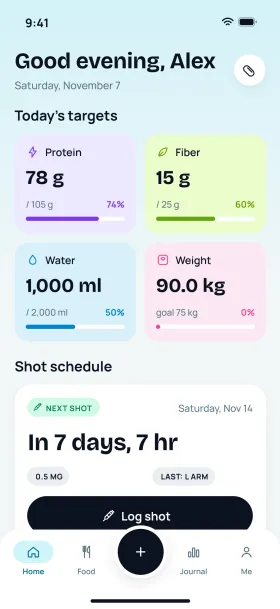
Penvia is a private logbook for people who take a weekly GLP-1 or GIP injection. It is a GLP-1 companion for the whole week: your shots, your food and your symptoms in one place. For symptoms, the app does this (from the App Store listing):
- One-tap notes. "Note nausea, constipation, heartburn, tiredness or low appetite with one tap and three strengths."
- Free. Side effects are in the free features, with the shot log, reminders, weight and water.
- Weekly Journal. "Review your week in the Journal: shots, protein days, weight and day cards."
- Doctor report (Pro, optional). A two-page PDF with your dose timeline, weight, side effects and shot table, to share at an appointment.
- Export. You can export all your data as a CSV file for free.
- Private. No account, no ads, no analytics. Penvia does not send your health data to a server of ours.
Penvia records what you tell it. It does not say if a symptom is normal, what caused it or what to do about it.
When to call your doctor
This page cannot tell you if a symptom is serious. Your doctor or pharmacist can. The official labels name some symptoms that need a call, and we quote them here.
- Severe stomach pain. The Ozempic, Wegovy, Mounjaro and Zepbound patient information all say: stop using the medicine and call your healthcare provider right away if you have severe pain in your stomach area (abdomen) that will not go away, with or without vomiting. The pain may go from the abdomen to the back. The labels link this to inflammation of the pancreas (pancreatitis).
- Gallbladder symptoms. The Wegovy patient information says to call your healthcare provider if you have pain in your upper stomach, yellowing of the skin or eyes (jaundice), fever or clay-colored stools.
- Serious allergic reaction. The Zepbound patient information says to stop using the medicine and get medical help right away if you have swelling of your face, lips, tongue or throat, problems breathing or swallowing, severe rash or itching, fainting or feeling dizzy, or a very rapid heartbeat.
- Low blood sugar signs. The Ozempic and Mounjaro patient information list signs such as dizziness or light-headedness, blurred vision, sweating, confusion or drowsiness and headache. The labels say the risk may be higher with another medicine that can lower blood sugar, such as a sulfonylurea or insulin.
This is what the labels say. It is not a full list and it is not advice for you. For an emergency, call your local emergency number. For anything else, ask your doctor or pharmacist, and show them your log.
Questions
What is a GLP-1 side effect tracker?
A GLP-1 side effect tracker is a log where you write each symptom with the date, your shot day, a strength score and a note. It can be paper, a spreadsheet or an app. It records what you feel. It does not diagnose and does not suggest a dose.
How often should I log side effects?
Write a row on any day you feel a symptom. Many people also add a short note on shot day, so the log shows the days around each shot. Ask your doctor if they want a different pattern.
What strength scale should I use?
Use a simple 1 to 3 scale: 1 mild, 2 noticeable, 3 strong. The numbers are only for you and your doctor. Keep the meaning the same each week.
Does Penvia tell me if a side effect is normal?
No. Penvia is a log, not a calculator and not a doctor. It records the symptom and strength you tap. If you are worried about a symptom, call your doctor or pharmacist.
Is my side-effect log private in Penvia?
Penvia has no account, no ads and no analytics, and it does not send your health data to a server of ours. Food lookups by barcode or typed words use Open Food Facts, an open food database. You can export your data as CSV.
Sources
- Ozempic prescribing information and patient information (FDA-approved label, DailyMed, published 10 Jun 2026)
- Wegovy prescribing information and patient information (FDA-approved label, DailyMed, published 30 Jun 2026)
- Mounjaro prescribing information and patient information (FDA-approved label, DailyMed, published 2 Sep 2026)
- Zepbound prescribing information and patient information (FDA-approved label, DailyMed, published 2 Sep 2026)